Selected works›Australian Popular Science Reported feature
The Drone Revolution
Unmanned aerial vehicles, or systems, or whatever your local regulator wants to call them, are here to stay. Drones are big business, and will make somebody a lot of money very soon nowOh boy, did we get that one right. By August 2025 CASA had issued more than 40,000 remote pilot licences, double the number at the start of the decade, and drone pilots are now Australia’s biggest group of pilots. Drone registrations grew 18 per cent in a single year. A study for the federal government reckons drones will add about $15 billion to Australia’s economy by 2040, with farming one of the big winners. And the house for sale down your street? Its listing almost certainly has a drone shot.. The only trick is figuring out exactly how to make that money, how long it’s going to take, and how obstructive the general public is going to be along the way.
When drones-as-a-service company Measure Australia was asked, by a major mining concern, to fly a drone inside an ore conveyor belt, they demurred. It was simply too risky – the metal covering over the conveyor could block the radio signal, and cause the drone to crash.
The mining company didn’t care. They wanted footage of their conveyor belt, so they hired an independent drone pilot instead. He flew his $40,000+ pro grade drone into the conveyor, and sure enough, the radio signal to his controller was blocked. The drone crashed, the conveyor was damaged, and total costs of the disaster were estimated at $5 million a week.
Such are the risks faced by Australia’s emergent drone industry.
Usually, when a disruptive new technology hits the big time, the really smart investors and backers have made millions before everyone else even realises what’s going on.
Drones aren’t exactly like that. Everyone seems to agree that they will be big – huge even – business. It’s just a matter of figuring out how the industry is going to work.
CEO of Measure Australia, Mark Stevens, has a fairly good grip on the problem. He, his son Aonghus, and a select group of pilots, technology experts and investors, have been working in this emergent industry since 2009.
“Drones are relatively cheap,” says Mark Stevens. “It’s easy for someone to go to a drone manufacturer and buy a very capable system. But there’s a provision in consumer law that says if you sell a product, your customer has to have a reasonable expectation of being able to operate it.”
Which is the problem with drones. You can sell a man a drone for $40,000 – a fraction of the cost of operating an actual crewed aircraft – but if he gets it home and realises he has absolutely no idea how to fly the thing, and you won’t help him, well, turns out he has grounds to sue.
“Measure Australia doesn’t sell drones,” says Mark Stevens. “We see our business as drones-as-a-service. You tell us what outcome you’re looking for, and we’ll figure out a solution. We aim to own the last 500 feet.”
Mark Stevens is of course referring to the mix of datasets available to businesses from satellites, aeroplane-based sensors, and actual ground-based fieldwork. Drones are unique in that they can get into areas that would take humans days or even weeks to traverse.
The only trick is getting the rest of society to accept them.
“After a series of devastating bushfires in WA,” says Mark Stevens, “we were perfectly positioned to fly drones in and assess insurance claims. Everything was lining up, it was perfect. But then the local government popped up and told us we couldn’t fly into the area. Because they were worried the residents would think the drones were UFOs.”
This is perhaps less of an irrational fear than you might think. What exactly is a “drone”? Measure Australia’s chief technology officer Aonghus Stevens admits it’s not exactly straightforward.
“In the CASA regulations, you’ll see references to unmanned aerial systems (UAS), unmanned aerial vehicles (UAV) and remote piloted aerial systems (RPAS).
“The regulations even include model aeroplanes. CASA mostly uses UAS, and the definition is really about how the system will be used, not its actual capability.”
CASA draws a distinction between hobbyist RC planes and, well, flying things that are used commercially.
“UAVs are commercial, UAS are not,” says Aonghus Stevens. “But the definition of commercial is confusing. We are on the phone to CASA all the time about it.”
Once, “commercial” used to mean flying your drone, taking pictures, and then asking for money. Now though, CASA has extended this to, for instance, mining companies using a drone to inspect pipelines for leaks, or even just checking fencing or powerlines.
“In the more remote areas, we’re using drones to monitor things, and that’s considered commercial even though there’s no direct payment,” says Aonghus Stevens.
Whatever the regulations, the industry itself generally uses the term “drone”. It might not be strictly correct – there are some who would insist the only true drone is a fully-autonomous system with no human operator – but it’s the word most people are using.
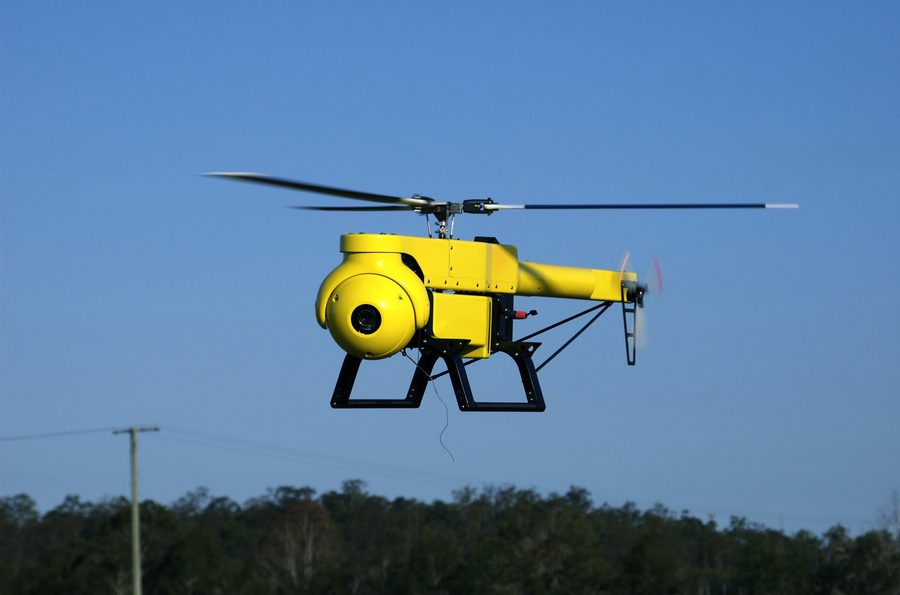
CASA, for its part, treats drones like any other aircraft. “Pilots need licences, based on the weight of the system,” says Aonghus Stevens. There are fixed-wing drones that look like ordinary aeroplanes, rotary drones that look like tiny helicopters, and of course the ubiquitous “multirotor” system that’s so hot right now in JB Hi-Fis and Harvey Normans across the country.
“The classes are being reworked, but they are based on weight,” says Aonghus Stevens. Systems range from diminutive mini-drones weighing less than seven kilograms, to serious airborne platforms weighing over 25kg.
“We think CASA is doing a good job,” says Aonghus Stevens, of the organisation’s management of the bewildering array of different drone types in the market right now. “We are expecting some big changes on the 29th of September, especially for aircraft under two kilograms.”
Basically, CASA is looking at simplifying the regulations for people operating drones that weigh less than 2 kg. That means your uncle can get his drone for Christmas and go and take a picture of a whale without too much paperwork.
Right now, of course, even the owner of a $700 Parrot Bebop who wants to use it for work has to get the same sort of licence as a professional.
The sheer accessibility of drones is something almost no other new industry has had to deal with. In the past, real disruption was, to some extent, moderated by massive start-up costs. Want to be an aerial photography company? Well, you’ll need half a million for a good plane, then hundreds of thousands more for licensing and training and certification.
“Back in 2012, just four years ago, a capable drone would cost more than $500,000,” says Aonghus Stevens. “And that drone would have been less capable than a $4000 DJI Phantom today.”
But the relatively low cost of drones can also be a trap. Measure CEO Mark Stevens tells of a mining company in the Pilliga that spent $40K or more on a drone, on the understanding it would have a 40 minute operating time. Yet out there, in the unforgiving blast furnace, its battery could manage barely eight minutes. For that company, their drone was almost useless.
Which is why Measure Australia believes the future of drones isn’t in selling hardware, but rather selling drones as a service.
“We view ourselves as a data company,” says Mark Stevens. “We ask clients ‘what outcome do you want’ and then we work backwards.”
Mark Stevens uses real estate as a key example. Many agents have realised the potential of drones in selling prestigious properties – fly the drone over the house, get some great pics, package it all into a YouTube video and watch the buyers fight each other for the opportunity to make an offer.
And indeed some real estate companies will hire an independent drone operator to get those shots. Yet this guy will be less a photographer than a drone geek. He can fly, says Mark Stevens, but can he shoot compelling video?
“Often clients will pay a drone operator and be really disappointed with the results,” Mark Stevens says. Or they will buy themselves a $2000 drone, fly it around a house, and wonder why the shots this consumer-grade toy takes look so terrible.
Measure Australia doesn’t want to provide a “drone service”. They want to provide awesome pictures of a multi-million dollar property. The drone is merely a means to an end.
That’s not to say that drones don’t represent an opportunity for businesses and organisations to get an eye in the sky for a fraction of the cost of a crewed aircraft.
For example, Mark Stevens thinks helicopters should be saved for the task of rescuing people. They shouldn’t waste time and fuel patrolling the coast looking for drowning surfers and sharks.
“Surf life saving organisations can spend up to six million dollars a year on [crewed] rotary flights,” Mark Stevens says. “That buys them 460 hours” of helicopters flying up and down the coastline looking for trouble.
“We quoted them three million for 4300 hours of constant surveillance,” he says. The idea would be that the drone would do the overwatch, and helicopters would be scrambled if anything did actually go down.
It represents a massive saving in fuel, let alone the costs of pilots and other crew. This is the real potential of drones: to do what humans would find tedious or impractical.
“Imagine a property with a thousand kilometres of fencing or powerlines,” says Aonghus Stevens. “A couple of guys in a 4WD might only be able to drive at 30km/h because of terrain. A drone could fly the line autonomously, programmed to report back only if it detected an anomaly.”
Before this potential can be realised, however, CASA has to get its head around one very important concept – operating drones beyond line of sight.
Right now, drone pilots must be able to see their airborne systems. Only the military can fly its drones over the horizon and conduct operations while the pilot sits in an air-conditioned shipping container on the other side of the world.
Measure Australia’s CEO Mark Stevens knows how beyond-line-of-sight affected the armed forces: he’s already had a long career in the military.
“Drones transformed the military in a matter of weeks,” he says. “And this will be transferred to the commercial sphere at some point.”
Like all good entrepreneurs, the team at Measure Australia identified that drones were going to be a big thing, and positioned the company to benefit from that as early as possible. But it hasn’t all been smooth sailing.
“We did not anticipate it would take from 2009 to 2015 for things to really get moving,” says Mark Stevens. He tells of endless meetings with mining bigwigs, explaining to them how drone services could give them new insight into mines and the infrastructure around them. Drones could go quickly into open pit mines to inspect the integrity of newly-blasted walls. They could patrol the thousands of kilometres of private railroad, tailing the autonomous trains as they trundle through the Pilbara.
Everything was falling into place. Mark Stevens was even about to board a plane to fly to Perth and start the signing process... but then the iron ore price collapsed, and just like that the deal was off.
“It really highlights how important it is to be able to respond quickly,” he says. No mining deal was a blow, but there’s still real estate, and an increasing number of custom jobs. It’s all about the data.
There will always be those freelance pilots to contend with, though. “Yes, we did used to be able to draw a distinction between a ‘pro’ grade drone and a, I guess, hobbyist drone,” says Aonghus Stevens. “But the line is blurring. I mean, look at the DJI Phantom 4. That’s a hugely impressive platform and it’s so quick and easy to deploy.”
In fact, the difference between the drone you or I might buy and, say, a $180,000 law enforcement drone like those used in California, is less about capability and more about ease of use.
“So that law enforcement drone has much greater endurance than something you could buy,” says Aonghus Stevens. “It can fly for 60 minutes instead of 40. It can also operate in the rain, has a camera with 30-times optical zoom, sends its data over an encrypted network, and it’s very easy to operate.”
When police are responding to an incident where a little drone recon might be helpful, it’s not always possible to dedicate an entire officer to manually fly the drone. Instead, these systems have much greater automation in their controls – the “pilot” can just tap on a map to send the drone to that location. No thumbsticks, no fuss.
“That’s ideal for when there’s lots of stuff going on in a dynamic situation,” says Aonghus Stevens.
The confusion over drone accessibility doesn’t just stop there. The market is little short of insane: Measure Australia knows of at least 1200 drone manufacturers trying to sell something right now.
What’s more, buying and playing with a drone is one of the easiest ways for an Australian to break the law without even realising it.
“The regulations really aren’t clear for the hobbyist,” says Aonghus Stevens. He explains that private owners are only supposed to fly on their own property, to a height of 120m. Of course, if you go down to any Sydney North Shore beach on a sunny Saturday these days, you’re likely to count four or five drones buzzing about.
And sure, down at the beach a drone is not much more of a nuisance than a camera with a telephoto lens. But playtime can turn awkward very easily.
“I was watching this beautiful bit of footage someone had shot over Watsons Bay,” Aonghus Stevens explains. “They flew along the shoreline and it was great. But then they came in past the Botanic Gardens, over the Opera House and up to the south pylon of the Harbour Bridge. That’s hugely problematic, because that’s restricted airspace. It’s one of the main helicopter flight paths through the CBD.”
Keen drone users have even put lives directly at risk. During severe bushfires in the US, the water bomber planes had to be waved off certain fire zones because there were too many drones in the air for a safe approach. People wanting to get amazing aerial footage of the fire were actively preventing the fire from being put out.
Fortunately, drone manufacturers are aware of this problem and doing what they can. Like a slightly more excitable version of the old “Don’t Steal Music” sticker on the screen of your new iPod, drone packaging includes pamphlets explaining where and how high you can fly your new toy.
If nothing else, the regulatory headache created by the general population now having access to $1500 flying machines big enough to get in the way of general aviation has really highlighted how hard it would be to license flying cars.
Part of the problem is that every amateur drone pilot thinks he (and it’s usually a he) is the only one. That buying a drone is still a kind of edgy thing to do. He’s the only one on the block with his own flying machine.
The rapidly increasing number of sole operators offering drone services puts paid to that.
Back to the portfolio